
MADE IN LONDON
Japanese-born, millinery designer Misa Harada, and Portobello Road's most famous vintage boutique owner, Jeff Ihenacho both grew up on council estates in South London. Fadé Ogunro meets up with them to discuss their success and how they avoided Britain's gang culture in the 80s- through fashion.
In a world where interviews with fashion designers and stylists tend to be orchestrated, supervised and manipulated to make the creative look as rarefied as possible, Misa Harada and Jeff Ihenacho are the exceptions- they lack that self-conscious eccentricity which usually makes fashion people hard to relate to …
It is a rainy weekday afternoon in Notting Hill and London is looking its worst. A few weeks before the forthcoming spring/summer '07 fashion shows, every designer is as erratic as the weather, not Harada. She is a gentle, bundle of amiably contained stress.
A dim back alley and a Dickensian stairway give way to a bustling studio which smells of smoke and instant coffee. I am greeted by a petite-woman who offers to take my coat and tries, with the ineptitude of a teenager but rather less cunning, to hide the fag that hangs from her hand. Waving away the smoke and blushingly apologizing, she introduces herself as Misa Harada. The woman whose hats were featured on TV Drama, "Sex in the City," designed Jennifer Aniston's wedding veil and hats for Janet Jackson's touring costumes. Misa Harada Millinery has been featured in national newspapers and international magazines including Vogue, The Face and the cover of iD Magazine.

From rebellious student to international trend-setter, Harada has come a long way since her conservative upbringing in Japan. Born in 1968 in Nagoya, she came to London when she was 18 to attend University. But her newfound freedom and the 80s fashion scene, which married street style and punk music, fueled her creative energy. "What made growing up in London in the 80s so great was the explosion of youth tribes. I dropped out of school and began heavily smoking and pub-crawling. This behaviour was very foreign for the rest of my family to understand," she says. Her mother was a busy model in Japan who was hardly at home. "I was raised by my father," she goes on, "I don't talk about it much but my parents are good admirable people and I hope that I've inherited some of their values."
Harada has certainly inherited qualities from her parents and culture. "Growing up with my mum, the house was filled with a dazzling array of clothes. I was never allowed to try them on, but I always helped [her] to pick an outfit. I guess this is where my first taste for fashion originated. London in the 80s was different," she says, "everybody wanted to show off their individuality and I was captivated by the street culture movements."
By the age of 20, Harada had worked for several shops on Carnaby St and on Kings Road by day, but at night she slept in the basement or warehouses of the stores. She was making all her decisions without parental guidance or financial support. It says a great deal for her likeability that she, a creative, mild-mannered type, was largely left alone to face tough, inner-city customers. She says, "Styling customers and working under designers, invigorated my artistic side. In Japan, it is very unlikely for a female to drop out of school and support herself. My father thought that without financial support from him, I would run back home, do as he wishes and finish my History degree." Fortunately for her father, she inherited his stubborn streak. Harada was a determined woman, upon deciding art and fashion were her life ambitions, she saved up all the money she had and enrolled herself into college- not just any college- The Royal College of Art; and had her first taste of hatmaking.
Most of her friends at the time were heavily drug or alcohol induced and life was all about raving and misbehaving- all which could be read about in the youth culture bible of the time- The Face or the NME. "I loved The Face and iD magazines as I was growing up; it was so different to Vogue, Japan. It was all about design, youth, freedom and street culture," she adds, "although I spent some tough years rebelling on the streets, I knew I wasn't going to be a failure; it all aided in fine tuning my understanding of youth trends which I try to captivate and translate in my designs." The work ethic of the Japanese community is very strong and you are shunned if you are unsuccessful. Children are given positive reinforcement only when they show drive, determination and ambition to succeed.
In what seemed like an anachronistic business, Harada has successfully redefined headwear fashion for a new global audience. "When I launched my business in the late 1990s, my goal was to break away from the millinery status quo and use eclectic, avant-garde design to woo a younger, more trend-conscious clientele," says Harada. The result? Today, Harada's surprisingly affordable headpieces are the hottest designs that dress the heads of TV stars, sports figures and even members of the Rolling Stones. Harada's designs captures the zeitgeist- she understands street culture and translates them into a
3-D expression you can wear.
The weather begins to brighten, so I seize the opportunity to say my farewells- not before purchasing two fabulous hats from Harada- and head towards Portobello Road, to meet vintage stylist and store-owner, Jeff Ihenacho. The tiny store is a dimly-lit Aladdin's Cave of luxury vintage clothes and second-hand delights. Packed from floor to ceiling with dresses, jackets, corsets, belts, bags, shoes and sunglasses. Pristine clothes and accessories hang from every available space; an Eighties Dior jumper, a Vivienne Westwood brocade jacket, a corset worn by Wendy James, Fifties Louis Vuitton sunglasses, a studded leather jacket and jewel encrusted clogs all command your attention when you enter.
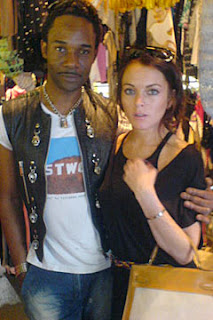
A tall black man, with neat dreads welcomes me with a genuine smile to, "One of a Kind." He is wearing a long, black, tailored Hermes leather coat, a Vivienne Westwood beanie hat, a matching shirt with a suede and silk mix Alexander McQueen, shoulder bag. His is a retro-classic style: Vivienne Westwood- meets YSL- meets Punkyfish! This is Jeff Ihenacho, a very unique man, "When customers come-in, they don't know where to look first," says the sparkly eyed Nigerian-born, man. "So I guide them through the store, find out what they are after and style them myself."
Every item of clothing has a history; everything has to be in pristine condition before it is allowed in the shop. The immaculate condition and variety of goods attracts not only celebrities, but also designers. Tom Ford, Jean Paul Gaultier and Stella McCartney have all visited the boutique, 'to search for inspiration.' However, Ihenacho takes great pleasure in increasing his prices, as he knows designers are looking for ideas for their collection.
He rolls a cigarette and invites me into his other office, a black-tinted 4x4 parked outside the boutique. "I'm a heavy smoker, but never around the clothes, it wouldn't be professional," he goes on, "besides the store is small enough to keep an eye on it from out here." He wisely invested in an in-car security system, which is linked to the shop; he can monitor all his customers' activities from the comfort of his jeep.
Ihenacho arrived in London in the 80s as a teenager, from his home in Lagos, intending to take a few years out before he returned to University. Like Harada, he too was quickly drawn to the individuality of designers like Vivienne Westwood and Ossie Clark. He developed a love of fashion and styling from his mother, who sold jewelry and clothes to her friends in Nigeria. "I've always been a mummy's boy, so much so, I was nicknamed her 'handbag.' It was my job to collect money from all her customers and in doing so, I learnt the foundations of running a business: cultivating long term relationships with clients, maintaining high quality products and regulating prices for advantageous purchasing deals." Unfortunately, Ihenacho's dear inspiration, his mother, passed away in his mid-twenties. She too was a collector of vintage designer clothing and left most of her clothes and accessories to him. He set up a stall in Portobello Road and began selling his mother's antique fortunes. This was all in an attempt to generate extra income for his large family. "Money was tight when I was growing up," he says quietly, "luckily my father always supported me. He encouraged any idea I had and pushed me to realize them.
"Although I was living in South London, most of my adolescent years were spent trawling through market stalls and charity shops. I find unusual, enchanting clothes at auctions or jumble sales." Ihenacho has been collecting vintage for 12 years and has finely tuned his taste to include Vivienne Westwood circa late 60s and 70s, Pucci and Dior. Having over-loaded his original Portobello stall with luxuries from car boot sales, markets, auctions and clothing fairs all over the world, Ihenacho opened his aptly named store, 'One of a Kind' in 1997. And now, he is the secret wardrobe weapon of the likes of Kate Moss, Naomi Campbell and most recently, Lindsay Lohan. Proof, if needed of his celebrity popularity is in the shop itself, where the walls are smothered in photographs of his well-known clients. Who knew mummy's little runner-boy would grow into an international business man, with impeccable style.
So, what attributes do the designer Misa Harada, and stylist Jeff Ihenacho, share except fashion?
They have both shared, at some point in their past, a sense of hopelessness. Misa lived in Croydon, Jeff in Streatham- both on council estates. They both endured miserable and terrifying years, where their future was uncertain and they were encouraged to find themselves and to invest in their interests. Growing up in the drug, sex and rock n roll era is perhaps not too dissimilar to today's youth culture of drugs, sex, and rap music.
"My father has always been my back bone," says Harada. "I never wanted to disappoint him or my younger siblings. In my culture, you are only respected if you make an honourable name for yourself. However, I was fortunate enough to gain success thorough rebelling." The youth today do not seem to be tapping into their creative talents, they are encouraged instead from gang culture and the media that the way to receive respect and 'rep' (represent) on the streets is through violence and guns. Does the problem stem from lack of parental support or specifically, a father-figure who is traditionally the provider of guidance in the family?
Perhaps the difference in the cultures of which both Harada and Ihenacho originated, plays a role in their entrepreneurial tendencies and thirst for success. The work ethic in both the Japanese and Nigerian community differs in terms of value. "The education system in Nigeria is very strict, you had to pass all the exams at school otherwise you would not move into the next year. You would have to repeat the entire year, and your classmates would tease you," says Ihenacho. Educational unintelligence is not an option in these cultures; after all, 'knowledge is power,' (Francis Bacon) is it not?
Although both Harada and Ihenacho discovered their talents and realised their dreams through fashion, this cannot be applicable to everybody. The point however is, as youths they valued and practiced the work ethics of their culture, integrated it into their personal development within London's community. Coupled with solid family upbringing, who valued education and ambition, Harada and Ihenacho arrived at success.
As far-fetched as it may seem, perhaps the beginning of the solution to the issues surrounding the youth today lies amongst parenting and culture. It is about ensuring that parents are given the foundation and education needed to raise a child, not only the physical aspects, but the disciplinary skills inclusive. I believe Britain's youth culture can ameliorate with time- we just have to instill a culture which eschews negative, destructive behaviour. We need to act more collectively as a community and take responsibility for our youths' dreams and offer them more opportunities for success.
Misa Harada and Jeff Ihenacho may not be household names but their different love and approach to fashion, propelled their entrepreneurial skills and transformed them into respected artists of their trade. After all, they both emerged from South London estates and have achieved global recognition within the fashion circle: They are the personification of hard work, ambition and perseverance-The question is: will today's youth be able to enforce these positive characteristics?
 fashion entreprenuers


